
Wednesday, October 12, 2005

Tuesday, October 11, 2005
It's Over...For Now

 The Braves post season hopes were dashed once again as they dropped game 4 to the Astros in a marathon 18-inning game. An uncharacteristic outing by Kyle Farnsworth allowed the game to be tied in the ninth. It was his first blown save since joining the team in early August. As for he Braves hitters, they just didn't get the hits when they needed them in the extra innings.
Despite the outcome, the game was truly momentous. It set records in number of innings played (18), game length (5 hrs. 50 min.), players used (42), pitches thrown (553), and grand slams (2). Even more amazing, the same lucky Astros fan caught both the Berkman grand slam ball in the 8th, and the game winner in the 18th. How about that?
I've finished grieving, and I'm looking forward to next season. At least the Yankees were eliminated as well. I'll be pulling for the Cardinals the rest of the playoffs.
Sunday, October 09, 2005
Paige's Artwork
Here's another of Paige's paintings. There are a couple others in the archives, so if you like this one check them out. She is beginning to warm up to the idea of selling them, so contact me if you are interested. Feel free to comment as well.


Saturday, October 08, 2005
Anthropological Field Trip
Part 1: Georgia Guidestones
Hopefully, you've read the previous post describing the monument I set out to find this past June 21st. It was the Summer Solstice, and personally, I think it should be a national holiday. I mean, come on, it's the longest day of the year. It should be celebrated. Anyway, I set out to visit the Guidestones in Elberton, Ga. I thought, since it was the solstice, some new agers or fringe occultists would be conducting some sort of nature based religious ceremony. I arrived just after noon, and of course, there was no one there. No chanters, no meditators, just me, my digital camera, and anthropological aspirations. I had brought a digital recorder as well. I had planned to interview some of the participants. I was a little let down. After all, this was the Solstice, man. Any pagan worth a damn should have been doing something that day. I was suprised no one was there. The entire visit was anti-climactic, actually. I mean, the Guidestones are a fascinating monument, but the astronomical alignment I had read about just seems to be well placed holes. I think the "alignment" of the Guidestones could be replicated almost anywhere, in any structure.
 Also, the message on the stones is a bit self evident. I seems that the authors think that if the world ends soon, future generations will be absent of common sense. I mean, the governmental principles of the Guidestones have been practiced for thousands of years. And I am a bit troubled by the population guidelines. What kind of social rules would be established to limit the human population to 500,000? They would infringe on your personal freedoms, at best. At worst, well, let your imagination run wild.
On a more positive note, it's incredible to think that these stones will remain in their postions for thousands of years to come. No matter what the future holds, this monument will remain to greet all visitors. Though I disagree with some of the guidelines, the perspective presented is no less valid than any of my ideas about the future. It is a positive statement for no other reason than it has been spoken, and it will be around long after the authors have perished. If you are in north Georgia, near Athens and the South Carolina line, take a detour over to Elberton, and check out America's Stonehenge. It is pretty interesting to see, and who knows, you may be hit with an epiphany while marveling at the granite monument.
Part 2: The Cherokee Center of the World
While touring Elberton, I discovered that the ceremonial center for the  Cherokee Nation was near by. I was not expecting to visit two sites in one day, but since I was in the neighborhood, I decided to find it. It took quite a while, even though it was only about 25 miles from the Guidestones. My anticipation built as I persevered through several wrong turns and miles of backtracking. And when I finally found the site, I was completely disheartened. I had wanted to find an open field with rolling hills; a place I could walk through, meditating upon the culture of the Cherokee and pondering the lives of my ancestors. Maybe I would even stumble upon an artifact to analyze back in the archeology lab at GSU. I should have expected what I found:
 Cherokee Nation was near by. I was not expecting to visit two sites in one day, but since I was in the neighborhood, I decided to find it. It took quite a while, even though it was only about 25 miles from the Guidestones. My anticipation built as I persevered through several wrong turns and miles of backtracking. And when I finally found the site, I was completely disheartened. I had wanted to find an open field with rolling hills; a place I could walk through, meditating upon the culture of the Cherokee and pondering the lives of my ancestors. Maybe I would even stumble upon an artifact to analyze back in the archeology lab at GSU. I should have expected what I found:

Despite the disappiontments of my excursion. I was encouraged by the fact that I had finally gone out to see the Guidestones, and I had persistented until I found the Cherokee Center of the World. These are lasting monuments to our future and our past. There remains much to be learned from previous cultures and the prospects of our future. We would do well to take them all into consideration as we go forward. While thinking of these positive aspects, I passed a sign that poignantly reminded me that I still have most of my life ahead of me, and I should get off my ass to make sure that I leave some kind of lasting mark on this world. 
Friday, October 07, 2005
The Georgia Guidestones

These stones, described below, caught my interest when searching the web on my last days in Jacksonville, FL. I stumbled across the website in a general search of things dealing the Druids. I was fascinated to find something so culturally significant in the middle of north Georgia. I set my mind to going to check them out, and I finally did on June 21st of this year, the summer solstice. Details of this trip will follow in my next post, but first, here's an introduction compliments of http://www.thegeorgiaguidestones.com/stones.htm
"Elberton Granite's reputation as one of the world's best monumental stones, Elbert County's geographic location, and fate seem to be key elements in why one of the nation's most unusual monuments was unveiled near Elberton, March 22, 1980. Already called "America's Stonehenge," after the mysterious monuments in England which have puzzled men for ages, THE GEORGIA GUIDESTONES has attracted nationwide publicity and promises to become a major tourist attraction.Overwhelming in size and steeped in enigma, the GUIDESTONES was revealed to the nation in the Winter, 1979, ELBERTON GRANITEER -- and is as much a mystery now as it was then -- and probably still will be when man ceases to record his history. The gargantuan, six-piece monument stands 19-ft. high in the beautiful hill country eight miles north of Elberton and proclaims a message for the conservation of mankind. Its origins and sponsors are unknown; hence, the mystery.
Challenging Project
The components were manufactured from ELBERTON GRANITE FINISHING COMPANY, INC.'s "Pyramid Blue Granite", and the firm's President, Joe H. Fendley, Sr., said the project was one of the most challenging ever for his quarrying and monument manufacturing concern - partly because of the magnitude of the materials and partly because of the exacting specifications from the mysterious group of sponsors, "and those specifications were so precise that they had to be compiled by experts on stone as well as construction," said Fendley.He said it all began late on a Friday afternoon in June when a well-dressed and articulate man walked into his offices on the Tate Street Extension in Elberton and wanted to know the cost of building a large monument to conservation. He identified himself as "Mr. Christian." He told Fendley that he represented a small group of loyal Americans living outside Georgia who wished to remain anonymous forever, and that he chose the name "Christian" because he was a Christian. He inquired where Fendley banked and Joe put him in touch with both local banks. Wyatt C. Martin, President of the Granite City Bank, was selected by "Mr. Christian" to be the intermediary for the mysterious project. According to Martin, the man showed up at his office 30 minutes later, explained the project, and said after completion he hoped other conservation-minded groups would erect even more stones in an outer ring and carry the monuments message in more languages. He told Martin that he wanted the monument erected in a remote area away from the main tourist centers. The gentleman also said that Georgia was selected because of the availability of excellent granite, generally mild climate, and the fact that his great-grandmother was a native Georgian.
Elbert County Chosen
Martin persuaded the mystery man that Elbert County was the ideal location for the memorial; and he agreed, provided a suitable location could be found. He returned later and he and Martin inspected sites. "Mr. Christian", who now called himself "R. C. Christian", chose a five-acre plot on the farm of contractor Wayne Mullenix. It is the highest point in Elbert County. A few weeks later , Martin contacted Joe Findley and told him that funds for the project were in an escrow account and to start work immediately. Martin promised that when the project was completed, he would deliver his file on the affair to the anonymous sponsors and that the secret would never be known.He said "Christian" told him that the sponsors had planned the monument for years and that the ten "guides" for the conservation of mankind and the earth were carefully worded as a moralistic appeal to all peoples of nationality, religion, or politics.The guides are brief maxims espousing population control and other conservation messages in eight languages. The guides are inscribed in eight different languages on four huge stones set in a paddlewheel arrangement with the center stone carved and drilled so that the sun will mark the time of day and the seasons. The guides, which were accompanied by ten explanatory precepts in the specifications, are: "Maintain humanity under 500,000,000 in perpetual balance with nature; Guide reproduction wisely - improving fitness and diversity; Unite humanity with a living new language; Rule passion - faith - tradition - and all things with tempered reason; Protect people and nations with fair laws and just courts; Let all nations rule internally, resolving external disputes in a world court; Avoid petty laws and useless officials; Balance personal rights with social duties; Prize truth - beauty - love - seeking harmony with the infinite; and , Be not a cancer on the earth - leave room for nature - leave room for nature.""
Location
The Guidestones are out in the middle of nowhere on a farm near Georgia State Highway 77, 7.2 miles North of Elberton Georgia, 1.3 miles South of Hart-Elbert County Line, 7.8 miles South of Hartwell Georgia.
Thursday, October 06, 2005
NLDS
I've been fortunate enough to attend both games of the series thus far. A short synopsis of each follows:
Game 1
 Tim Hudson is a gamer. I've seen him pitch several times this season, but he did not have his stuff for this one. He gave up five walks through the third inning and finally seemed to settle down. The Astros got to him again in the beginning of the 7th, and Cox pulled him. Rookie, Devine, followed with a quick out, but after that, Rietsma and Foster combined to give up 5 hits and 5 runs in the 8th, successfully nullifying another Jones/Jones homerun tandum. The Astros won 10-5.

On a lighter note. My Dad made the trip from Blackshear, GA to attend the game with me. He and I have a lot of great memories of games at Turner Field and Fulton County Stadium, but this one was a heart breaker. We still had a great time hanging out, but this was the only game he has been able to attend this season. I wish he could have witnessed a solid win.
Game 2
 Smoltzie showed up and delivered a gem. He pitched 7 innings and gave up 1 run while striking out 5. We rocked the "Rocket" for 6 hits and 5 runs in 5 innings. The fireworks came from rookie Brian McCann, an Atlanta native who ripped a 3 run homer in the second. It was all Braves from then on. Great defense and steady run production led to a Braves win with a score of 7 to 1.
My wife, Paige, was in attendance with me, and we had a great time. I think Sosa will produce a win for us on Saturday, but I'm still going to get tickets for a prospective game 5. I will keep you "posted". GO BRAVES!
Game 1
 Tim Hudson is a gamer. I've seen him pitch several times this season, but he did not have his stuff for this one. He gave up five walks through the third inning and finally seemed to settle down. The Astros got to him again in the beginning of the 7th, and Cox pulled him. Rookie, Devine, followed with a quick out, but after that, Rietsma and Foster combined to give up 5 hits and 5 runs in the 8th, successfully nullifying another Jones/Jones homerun tandum. The Astros won 10-5.
On a lighter note. My Dad made the trip from Blackshear, GA to attend the game with me. He and I have a lot of great memories of games at Turner Field and Fulton County Stadium, but this one was a heart breaker. We still had a great time hanging out, but this was the only game he has been able to attend this season. I wish he could have witnessed a solid win.
Game 2
 Smoltzie showed up and delivered a gem. He pitched 7 innings and gave up 1 run while striking out 5. We rocked the "Rocket" for 6 hits and 5 runs in 5 innings. The fireworks came from rookie Brian McCann, an Atlanta native who ripped a 3 run homer in the second. It was all Braves from then on. Great defense and steady run production led to a Braves win with a score of 7 to 1.
My wife, Paige, was in attendance with me, and we had a great time. I think Sosa will produce a win for us on Saturday, but I'm still going to get tickets for a prospective game 5. I will keep you "posted". GO BRAVES!
HOUSTON, YOU HAVE A PROBLEM.
Tuesday, October 04, 2005
NLDS Preview
 Record vs. Astros
The Braves won five of their six games against the Astros this year. Most of the damage was done during a four-game series sweep at Turner Field on May 5-8. Since then, the two teams haven't met and the Astros have turned around their season. When the Astros limped out of Atlanta, they were just 11-19. Since May 24, Houston has vaulted out of last place and into the postseason with a 74-43 record.
2005 Stats vs. Astros
Giles batted .458 (11-for-24) with five doubles in six games against the Astros this year. Langerhans, a native Texan, batted .417 (5-for-12) with three homers in five games against Houston. On April 18, in a 1-0, 12-inning victory over the Astros, Langerhans hit his first career homer. His first career multihomer also came against them in a 16-0 win on May 8.
John Thomson, Mike Hampton and Hudson all provided nine-inning efforts against the Astros this season. Thomson was the only Braves pitcher to make two starts against the Astros. He was charged with seven of the 13 runs Houston scored in six games against Atlanta pitchers.
Career vs. Game 1 starter Andy Pettitte

Julio Franco: .471 (8-for-17), 1 HR, 1 RBI
Todd Hollandsworth: .400 (2-for-5) 0 HR, 0 RBI
Chipper Jones: .375 (6-for-16), 0 HR, 3 RBIs
Andruw Jones: .278 (5-for-18), 0 HR, 2 RBIs
Johnny Estrada: .161 (1-for-6) 0 HR, 1 RBI
Brian Jordan: .091 (1-for-11) 0 HR, 0 RBI
Rafael Furcal: .000 (0-for-6) 0HR, 0 RBI
Marcus Giles: .000 (0-for-3) 0 HR, 0 RBI
Wilson Betemit .000 (0-for-2) 0 HR, 0 RBI

Career postseason
Wilson Betemit (1 G, .000, 0 HR, 0 RBI)
Jim Brower (2 G, 3 IP, 0-0, 6.00 ERA)
Johnny Estrada (5 G, .353, 2 HR, 4 RBI)
Kyle Farnsworth (8 G, 8 IP, 0-0, 6.75 ERA)
Julio Franco (24 G, .235, 2 HR, 5 RBI)
Rafael Furcal (18 G, .253, 2 HR, 6 RBI, 6 SB)

Marcus Giles (21 G, .222, 2 HR, 6 RBI)
Todd Hollandsworth (14 G, .364, 0 HR, 3 RBI)
Tim Hudson (7 G, 34 IP, 1-2, 3.44 ERA)
Andruw Jones (71 G, .258, 9 HR, 28 RBI)
Chipper Jones (87 G, .294, 12 HR, 45 RBI)
Brian Jordan (35 G, .252, 6 HR, 27 RBI)
Adam LaRoche (5 G, .235, 1 HR, 4 RBI)
Eddie Perez (30 G, .299, 3 HR, 12 RBI)
Chris Reitsma (3 G, 3 IP, 0-0, 18.00 ERA)
John Smoltz (39 G, 200 IP, 14-4, 4 SV, 2.70 ERA)
John Thomson (1 G, 0.1 IP, 0-0, 0.00 ERA)
Compiled by Mark Bowman
Monday, October 03, 2005
Jeremy's Photos
Pal and T-shirt entrepreneur, Jeremy T., sent me some photos recently. Here are a few of my favorites:



He also sent many of himself and his family that I particularly enjoyed, but without consent, I would not be comfortable posting them. I look forward to getting some more from him, and I'll post my favorites then as well. I already plan to use one other in a separate post that is coming up soon.
Sunday, October 02, 2005
Novocaine Stain
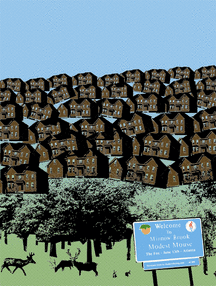
When I can work out how it was
Then I'll tell you
TV stained my memories, yeah
I don' think that she's...
Remember through sounds
Remember through smells
Remember through colors
Remember through towns
With fear and fascination
On what was here
And what's replacing them now
Interchange plazas a mall
And crowded chain restaurants
More housing developments go up
Named after the things they replace
So welcome to Minnow Brook
And welcome to Shady Space
And it all seems a little abrupt
No I don't like this change of pace
Saturday, October 01, 2005
KITTIES
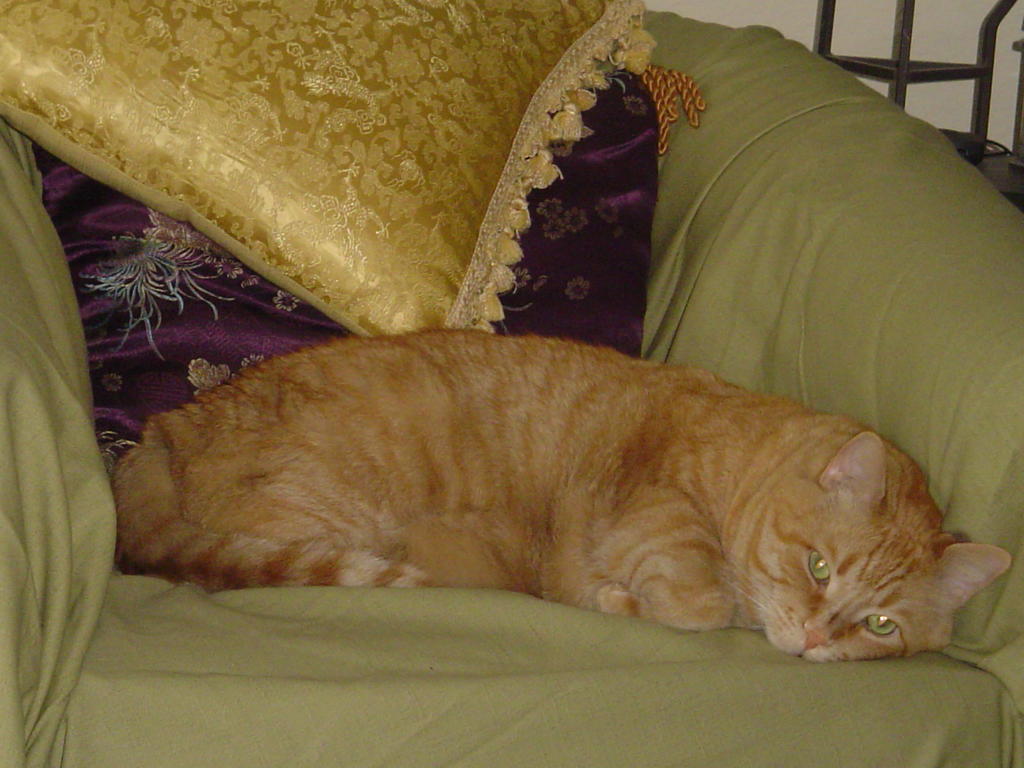
At this time, I would like to present: OUR CATS. Yeah, they seem cute, but they are both 20 pounders. They will get you. Just ask my paw-in-law.

Jonsey: Named after the main
character in the Stephen King
book I was reading at the time,
Dreamcatcher. We should have
named him Garfield; he weighs
24 pounds and gets cranky if he
doesn't have food.

Jonsey: Named after the main
character in the Stephen King
book I was reading at the time,
Dreamcatcher. We should have
named him Garfield; he weighs
24 pounds and gets cranky if he
doesn't have food.
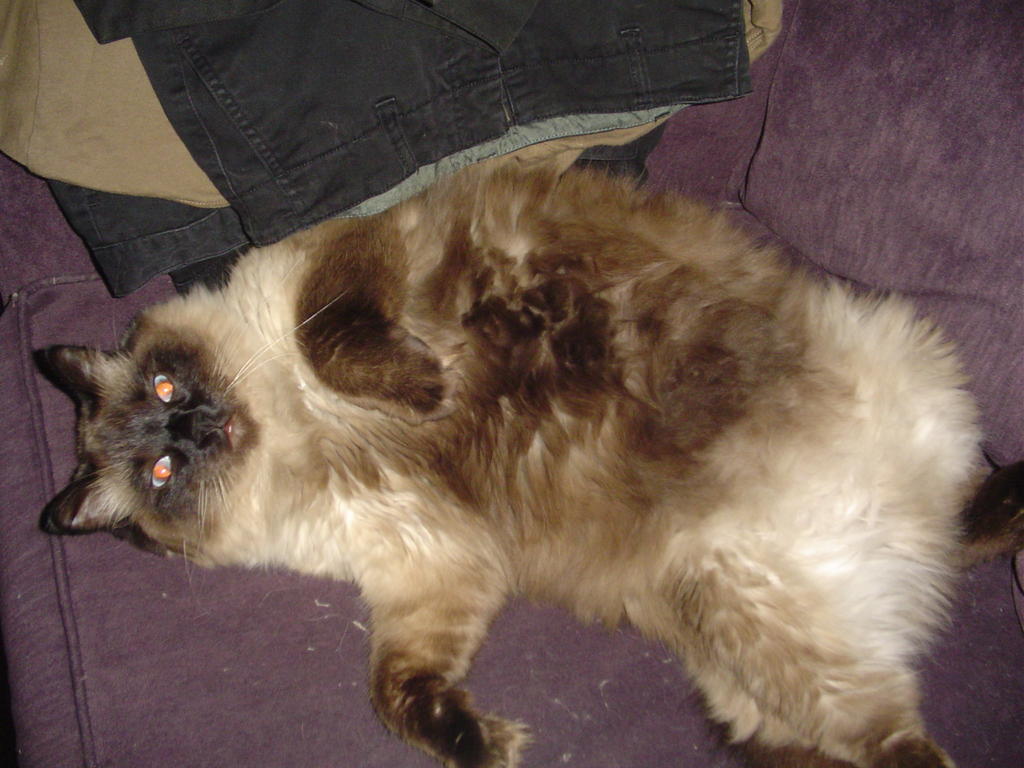
Ahi: A perfect name for a cat.
It's a term that refers to sushi
grade tuna. Weighing in at 19
pounds, he's a bit of a brute as
well.
Like the Braves and the post season...
I'M BACK! I plan to post regularly now, so keep checking. Jeremy, you can expect some comments from me soon. I like what you have been doing. Especially the "diamonds" post. Hilarious.
My meatwad photo does not show up for me anymore. Is it showing up for anyone else? Maybe I need to switch things up. Let me know.
My meatwad photo does not show up for me anymore. Is it showing up for anyone else? Maybe I need to switch things up. Let me know.
Wednesday, September 14, 2005
Analytical Reasoning
I decided to give an example of the type of study that occupied me recently. I copied this question from a google search, so I have not completed the scenario. I want us to do it together. Work it out and leave the results in a comment. I will do the same, if anyone decides to participate. Have fun:
Exactly six trade representatives negotiate a treaty: Klosnik, Londi, Manley, Neri, Osata, Poirier. There are exactly six chairs evenly spaced around a circular table. The chairs are numbered 1 through 6, with successively numbered chairs next to each other and chair number 1 next to chair number 6. Each chair is occupied by exactly one of the representatives. The following conditions apply:
Poirier sits immediately next to Neri.
Londi sits immediately next to Manley, Neri, or both.
Klosnik does not sit immediately next to Manley.
If Osata sits immediately next to Poirier, Osata does not sit immediately next to Manley.
1. Which one of the following seating arrangements of the six representative in chairs 1 through 6 would NOT violate the stated conditions?
(A) Klosnik, Poirier, Neri, Manley, Osata, Londi
(B) Klosnik, Londi, Manley, Poirier, Neri, Osata
(C) Klosnik, Londi, Manley, Osata, Poirier, Neri
(D) Klosnik, Osata, Poirier, Neri, Londi, Manley
(E) Klosnik, Neri, Londi, Osata, Manley, Poirier.
2. If Londi sits immediately next to Poirier, which one of the following is a pair of representatives who must sit immediately next to each other? (
A) Klosnik and Osata
(B) Londi and Neri
(C) Londi and Osata
(D) Manley and Neri
(E) Manley and Poirier
3. If Klosnik sits directly between Londi and Poirier, then Manley must sit directly between
(A) Londi and Neri
(B) Londi and Osata
(C) Neri and Osata
(D) Neri and Poirier
(E) Osata and Poirier
4. If Neri sits immediately next to Manley, the Klosnik can sit directly between (
A) Londi and Manley
(B) Londi and Poirier
(C) Neri and Osata
(D) Neri and Poirier
(E) Poirier and Osata
5. If Londi sits immediately next to Neri, which one of the following statement must be false?
(A) Klosnik sits immediately next to Osata
(B) Londi sits immediately next to Manley
(C) Osata sits immediately next to Poirier
(D) Neri sits directly between Londi and Poirier.
(E) Osata sits directly between Klosnik and Manley.
Exactly six trade representatives negotiate a treaty: Klosnik, Londi, Manley, Neri, Osata, Poirier. There are exactly six chairs evenly spaced around a circular table. The chairs are numbered 1 through 6, with successively numbered chairs next to each other and chair number 1 next to chair number 6. Each chair is occupied by exactly one of the representatives. The following conditions apply:
Poirier sits immediately next to Neri.
Londi sits immediately next to Manley, Neri, or both.
Klosnik does not sit immediately next to Manley.
If Osata sits immediately next to Poirier, Osata does not sit immediately next to Manley.
1. Which one of the following seating arrangements of the six representative in chairs 1 through 6 would NOT violate the stated conditions?
(A) Klosnik, Poirier, Neri, Manley, Osata, Londi
(B) Klosnik, Londi, Manley, Poirier, Neri, Osata
(C) Klosnik, Londi, Manley, Osata, Poirier, Neri
(D) Klosnik, Osata, Poirier, Neri, Londi, Manley
(E) Klosnik, Neri, Londi, Osata, Manley, Poirier.
2. If Londi sits immediately next to Poirier, which one of the following is a pair of representatives who must sit immediately next to each other? (
A) Klosnik and Osata
(B) Londi and Neri
(C) Londi and Osata
(D) Manley and Neri
(E) Manley and Poirier
3. If Klosnik sits directly between Londi and Poirier, then Manley must sit directly between
(A) Londi and Neri
(B) Londi and Osata
(C) Neri and Osata
(D) Neri and Poirier
(E) Osata and Poirier
4. If Neri sits immediately next to Manley, the Klosnik can sit directly between (
A) Londi and Manley
(B) Londi and Poirier
(C) Neri and Osata
(D) Neri and Poirier
(E) Poirier and Osata
5. If Londi sits immediately next to Neri, which one of the following statement must be false?
(A) Klosnik sits immediately next to Osata
(B) Londi sits immediately next to Manley
(C) Osata sits immediately next to Poirier
(D) Neri sits directly between Londi and Poirier.
(E) Osata sits directly between Klosnik and Manley.
Monday, September 12, 2005
Filler
I'm pretty busy this month with some other stuff, so I will not be making many posts. In the meantime, I do have a few things I can post until October.
This is another of my drawings inspired by bhiggi's characters. Too many people have said what the character exclaims to take or assign credit, but I've always liked the juxtaposition.
This is another of my drawings inspired by bhiggi's characters. Too many people have said what the character exclaims to take or assign credit, but I've always liked the juxtaposition.

Thursday, September 08, 2005
SWEEP...SWEEP...SWEEP
 The Braves finished off their sweep of the Mets last night in dramatic fashion. Ryan Langerhans, one of the thirteen rookies that have graced the Braves roster this year, came through with a game tying double in the ninth and a game winning single in the tenth to put the Braves on top. Paige and I attended, and it was a nail biter. Also, I was lucky enough to get three more BP balls. Two were caught; one was gotten after it landed. It's likely this is the last game of the regular season we will be able to attend, but we are planning to attend some post season games. She and I have fortunately seen the first and last games of the last three seasons. Hopefully, in the last game we see this year we will celebrate another Braves World Series title.
When we went to the game on Labor Day, I had run out of clean Braves shirts to wear, so I had to make one myself. My photoshop skills need some work, but I thought Jeremy would get a kick out of it:

Wednesday, September 07, 2005
MVP...MVP...MVP
 Last month, Jones led the National League with 11 home runs and 29 RBIs, and for his efforts, has been named the National League Player of the Month for August. This is the second Player of the Month Award this season for Jones, who won for June.
"He should be the leading candidate [for MVP]," said pitcher John Smoltz. "No disrespect to the other guys. I think any time you tee up a season, Pujols is an MVP. But in this situation, if the season were to end today, the Atlanta Braves wouldn't be in first place without Andruw Jones.”
"My main concern is to go out there and win and prove to everybody that [even though] we have a young team, we're looking forward to [another division title] and getting back to the World Series," said Jones.
Source: Andrew Worob w/ MLB.com

Tuesday, September 06, 2005
This Cartoon Cracks Me Up
This is a relatively new addition to the Cartoon Network's lineup. I don't watch too many of the regular cartoons since my DBZ obsession has ended. I primarily watch Adult Swim. But this one really cracks me up. You should check it out when you can. I believe it airs at 4 in the afternoon. Yes, I am a dork. No, I am not high.


Paige likes it too. This is a photo taken in front of a new addition to the TED, called Tooner Field.

Monday, September 05, 2005
A Braves Weekend
This has been the best Labor Day Weekend. Paige and I were both off work, and the Braves were at home. She and I are both fans, and thanks to Ebay and student discounts, we got some great deals on tickets. For the three games we went to, the ticket value was $104. Luckily, we only paid $47. They were all great seats, too. Now, to the games' details:

9/4: Braves vs. Reds
This game was a long one, 12 innings in the Atlanta sun. Marcus Giles was the star for the Braves. He had 2 homeruns, a double, and 2 diving catches at second base. It was incredible! Unfortunately, Cox had to put Kolb in to pitch the 12th. He gave up five runs, including a grand slam, resulting in a loss for the home team.
9/5: Braves vs. Mets
 In this one, the Jones Boys each homered. It's the 48th time that has happened. Andruw's blast was 452 feet, quite a shot. Chipper's hit barely cleared the center field wall, but it proved to be the game winner. John Thompson had a top quality start for the Braves, and he really needed it. He has not been the same since coming back from his injury in May. Jeff Francouer had another stellar afternoon as he makes his bid for
  the National League Rookie of the Year. He and Andruw have to be the best outfield tandum in the league. Not only did Andruw make an outstanding diving catch, but Francouer gunned down a run at home plate in the 6th. It was an amazing throw. We were sitting a few rows back from the right field wall, and it was a laser to home plate. The throw never went over head high. Francouer has only played 48 games this season, but he is tied for the league lead in outfield assists.
Enough about Francouer, another Georgia boy joined the team in August, and he is slowly becoming the Braves closer. Kyle Farnsworth came in the 9th inning and shut the Mets down. This guy is 6"4" 240 lbs and throws 100 mph. Talk about intimidating. Anyway, he got his 10th save of the season as the Braves triumphed over the Mets, 4 to 2.

9/4: Braves vs. Reds
This game was a long one, 12 innings in the Atlanta sun. Marcus Giles was the star for the Braves. He had 2 homeruns, a double, and 2 diving catches at second base. It was incredible! Unfortunately, Cox had to put Kolb in to pitch the 12th. He gave up five runs, including a grand slam, resulting in a loss for the home team.
9/5: Braves vs. Mets
 In this one, the Jones Boys each homered. It's the 48th time that has happened. Andruw's blast was 452 feet, quite a shot. Chipper's hit barely cleared the center field wall, but it proved to be the game winner. John Thompson had a top quality start for the Braves, and he really needed it. He has not been the same since coming back from his injury in May. Jeff Francouer had another stellar afternoon as he makes his bid for
  the National League Rookie of the Year. He and Andruw have to be the best outfield tandum in the league. Not only did Andruw make an outstanding diving catch, but Francouer gunned down a run at home plate in the 6th. It was an amazing throw. We were sitting a few rows back from the right field wall, and it was a laser to home plate. The throw never went over head high. Francouer has only played 48 games this season, but he is tied for the league lead in outfield assists.
Enough about Francouer, another Georgia boy joined the team in August, and he is slowly becoming the Braves closer. Kyle Farnsworth came in the 9th inning and shut the Mets down. This guy is 6"4" 240 lbs and throws 100 mph. Talk about intimidating. Anyway, he got his 10th save of the season as the Braves triumphed over the Mets, 4 to 2.
Sunday, September 04, 2005
How is the concept of race dichronically defined in Biological Anthropology?
What follows is an historical analysis of the concept of race as defined in Anthropology. I hope that if you read it, you will come to understand racial designation as a social construction, not a biologically determined catagorization. Comment if there are questions. I'll do my best to explain these concepts further.
A substantial amount of diversity and variation exists in all forms of life on this planet. One can discover environments teeming with organisms in nearly every nook and cranny of the globe, and evidence shows that individuals conducted investigations of these creatures throughout history. The desire to categorize this multitude remains as prevalent now as always. In order to study the abundance of life comprehensively, academics must organize their characteristics and unique features that distinguish them from every other living thing. They must biologically define the traits exhibited by the objects under investigation. When attempting to accomplish this in the species known as Homo sapiens, naturalists sparked a debate that remains unsolved in the present day. Concepts of human diversity permeate all levels of society. Issues of race are found everyday, in every culture, in every part of the world. Alliances are based on them, and enemies are sworn by them. People develop or neglect personal relationships due to their perceptions of race. This convoluted mess of racial interpretations brings an inexhaustible amount of conflict. In order for an individual to gain an understanding of race and its complexities, a person begins with its inception.
Variety in the animal domain has been a topic of interest since the days of the first documented philosophers in the fourth century before the Common Era. Aristotle contemplated this fact among many others. In this endeavor, he organized known life on the planet into distinguished categories he called, scala naturae. He coined the concept as “The Great Chain of Being”, and he based it on his belief that all beings in God’s creation should be arranged from the simplest organism to the most complex in ranked order. In this system, many aspects of physical complexity organized organisms: Amount of legs, outer covering, colors, etc. Humans reigned supreme and others fell in behind them. The bottom rung of the hierarchy held zoophytes, organisms similar to plants. (Jurmain, 2003; www.artchive.com, 2003; www.suite101.com, 2003; www.strangescience.net, 2003)
During European expansion in the eighteenth century, people were introduced to individuals distinctly different from themselves. This led to ponderings regarding the classification of human beings. In this day, intellectuals believed there was a fixed number of static organisms inhabiting the world. They perceived the study of these creatures was simply a matter of data accumulation and organization. (Molnar, 1998) One naturalist, Carolus Linnaeus established a classification of plants and animals that expanded upon Aristotle’s theory. He published his Systema Naturae as a guide to the planet’s biological diversity. In this taxonomy, he labeled humans as Homo sapiens and defined them as a member of a group called Primates. With exploration and discovery, new human variations became known, and Linnaeus applied his taxonomy to human diversity. (Jurmain, 2003; Marks, 1994) He established a hierarchy among Homo sapiens through the construction of four subspecies named for geographic domain and physical characteristics of skin color, hair form, stature and shape of nose. Eventually, he incorporated behavioral characteristics as a means to broaden the definitions of these distinct groups. He named these subspecies American, European, Asiatic, and Negro. (Molnar, 1998) These ambiguous descriptions fostered trends in biological determinism that haunt the study of racial diversity among humans.
Comte de Buffon and Johan Friedrick Blumerbach revised Linnaeus’s taxonomy. Buffon was the first to apply the term, race, to humans, and Blumerbach altered the characteristics defining subspecies. He utilized the skull as the defining trait among Homo sapiens. It was believed that the skull was the part of the body most resistant to change. Also, it was discerned that since the skull holds the brain, its characteristics are indicative of the capacities of an individual. After conducting research, Blumerbach concluded that the most “ideal” human was Caucasoid. He considered his other classifications; Mongoloid, American Indian, Ethiopian, and Malay to be inferior. (Molnar, 1998)
Over the next several decades, statistical calculations of cranial variation, anthropometry, were implemented to further distinguish races. Many investigators continued to search for “perfect” representations of particular populations. This branch of discovery, called phrenology, resulted in defined traits that supported the growing number of racial distinctions. Anders Retzius aided development of these new typologies of skull morphology that further distinguished races within previously classified geographic boundaries. As with other methods, these theories were based on physical characteristics that enabled productive investigation of human diversity in order to discover migration patterns between distinct populations. Continuing the trend, scientists applied these features to behavioral patterns to further elitist interpretations of human diversity. Pierre Paul Broca was one such scientist. Like his predecessors, he believed anthropometry could be used to classify physical distinctions among humans. In addition, he thought he could discover behavioral patterns that could be linked to cranial features in order to show racial differences as unchanging and continuous. In his opinion, physical traits were measures of intelligence and status, in addition to measures of biological variation. (Molnar, 1998)
Phrenology as a science disappeared in the late nineteenth century, but the concepts of physical characteristics linking individuals with their intelligence and behaviors continued to flourish. Samuel Morton and George Glidden furthered these perceptions through analysis of Native American and Egyptian skulls. Morton purportedly found that Native Americans had a smaller cranial capacity than Europeans; therefore, the Natives were intellectually inferior. He even reported that skulls of Caucasoid dimensions were found at mound sites around the Americas. In his view, the findings proved that a superior race of humans, Caucasoid, was responsible for the complex constructions of archaic origin. Coincidentally, Morton exemplified features of the Caucasoid race. Glidden produced similar results in Egypt. Utilizing the same methods of analysis, he concluded that the Caucasoid race was responsible for the erection of the pyramids. These findings continued the exploitation of scientific methods in support of ideals that held Caucasoids, Europeans, as superior to all other realms of human diversity. The work of these scientists encouraged biological distinctions as cultural bias. (Molnar, 1998)
Around this time, Darwin’s evolutionary theories brought about new explanations of human diversity. His theory of natural selection led to broader analysis of our species, but anthropometry continued as scientists were faced with new opportunities to investigate similarities and differences among humans and the relationship of these features to behavior. This was all done to support the early concepts established by Aristotle. Members of the perceived superior race conducted the investigations to further establish and maintain dominance over other geographic populations. It was believed that with continued investigation, race specific behavioral patterns and characteristics would emerge to definitively prove the taxonomies of human diversity. (Molnar, 1998)
In his studies seeking the ideal European, Lambert Quetelet attempted this to no avail, but his analysis was influential in the studies of Francis Galton, who took the concept further. In 1869, he published Hereditary Genius, which built upon Quetelet’s data. He utilized the information he acquired to statistically determine the shared traits and variations among human races. His results were graphed in a parabola where shared traits were located at the apex, and variable traits were distributed along the extremities of the graph. Commonly referred to as the “bell-curve”, this analysis gave insight into the purity of an individual. Galton began to correlate this with status and intellect. Upon further study, Galton thought he had proven hereditary procreation of intelligence, concluding that further human evolution could not occur through the support of weaker individuals. Herbert Spencer produced further evidence that Darwin’s theories could not exist in human populations as long as the weak and feeble minded were allowed to pass on inferior traits. With these theories, also called eugenics, scientists sought to improve the Caucasoid race through procreation of socioeconomic elites. (Molnar, 1998)
These typologies and biases remained prominent in the works of Karl Pearson and Charles Davenport, and the continuation of these concepts persists in modern analysis in the work on Carlton Coon. Throughout history, there have been scientists that challenge these methodologies based on the lack of practical evidence. In Linnaeus’s time, James Cowles Pritchard rejected classification systems based on anthropometry. He noticed that there was no perfect representation of any taxonomic species, and by definition, to be defined as a subspecies, an organism must be recognizably distinct from other units of the species. Taxonomies also assume the presence of static processes in the natural world. This misleads because many traits are simultaneously affected as a result of environmental variation. (Gould, 1977; Molnar, 1998) Other biologists were also skeptical as it became more wide spread that categorization can be too ambiguous. They found it incorrect to designate distinct groupings based on dynamic, natural variation. In the early years of the twentieth century, Franz Boas figured prominently in disputing typographical research. He found the shortcomings to be as they always had been. No factor of heredity can be conclusive for all members of the particularly defined racial group. In his arguments, the existence of dynamic variation was enlisted to dispel the elitist concepts of his contemporaries. Boas, along with Alfred Kroeber, pounded eugenic theories with contradictions. They did not succeed in eliminating the ideas from scholarly investigation, but their efforts did spurn a schism in anthropology as the nature vs. nurture debate came into fruition. (Gould, 1977; Molnar, 1998)
Regardless of the contradictions, racial typologies persisted as no efficient method of analyzing variation existed. However, in the last few decades, scientists have developed methods and discovered concepts that help disprove taxonomic designations of racial diversity among Homo sapiens. Scientists developed a system called multivariate analysis that allowed continuous scrutiny of dynamic species. This development spurned a transition from dependence on complex taxonomies of diversity in favor of more continuous, statistical investigation. This method allows investigation of alterations in a species over time and through the environmental conditions of its geographic area. It considers the diversity among and between species as well as their similarities and differences. Some technological advancements have brought about the ability to define the elements of human diversity on a cellular level. Most notably, the discovery of DNA has played a role in dispelling traditional concepts of race. When variation can be investigated on a sub-genetic level, common physical traits lose their weight as defining characteristics. Another concept emerged in the 1960s. Clinical distribution of individual traits reflects the influences of natural selection and gene flow. This method of analysis limits biases in racial designation as it investigates diversity through exclusively evolutionary forces. With these developments, previous concepts of natural selection, genetic drift, and gene flow become more accurately and efficiently calculable. (Gould, 1977; Jurmain, 2003; Molnar, 2003)
Modern methods of research have resulted in a more flexible and comprehensive view of diversity that has no fixed biological or geographic restrictions. Biological evidence has always been used to distinguish populations from one another, but the concept of biodeterminism has always been used in a cultural context, to establish the superiority of one distinction over another. Migration and exploration have occurred throughout history, these population movements and climatic changes have been the source of human variation. There can be no defined races if gene flow has been apparent across space and time. Racial categories are cultural constructions that attempt to find support in biological theory. Society has become grid locked by the prevalence of these ethnocentric, European ideals. Convoluted racial distinctions have infiltrated all aspects of life, especially with the emergence of concepts of economic globalization in the late twentieth century. Historically, concepts of race have resulted in the production of social identity that is easily recognized by others though not distinguished by nature. (Gould, 1977; Marks, 1994; Molnar, 1998)
Geographic variability exists in known fact, but race is simply a concept. Though methods of classification resulting in ambiguous nomenclature help increase our understanding of human variation; in reality, these labels encourage beliefs in static environments and polarize factions that support hierarchal stratification. These ideals are set in cultural distinctions and socioeconomic status; not science. The exploitation of biological facts to support elitist perceptions can only be achieved through diachronic analysis of related theories.
To quench a fire, you must extinguish its fuel. In anthropology, we must achieve this by debunking biological theories in concepts of race. Only then can we begin to fully realize the cultural constructions that serve to separate geographic populations from one another.
Bibliography
Gould, S. J. “Why We Should Not Name Human Races -- A Biological View”. Ever Since Darwin. Pgs. 231-236. 1977.
Jurmain, Robert; Kilgore, Lynn; Traventaan, Wenda; Nelson, Harry. Introduction to Physical Anthropology. Pgs. 24-25; 395-397. Wadsworth/Thompson. 2003.
Marks, Jonathan. “Black, White, Other”. Biological Anthropology: An Introductory Reader. Pgs. 159-162. 1994.
Molnar, S. “Racial Variation and the Perception of Human Differences”. Human Variation, 4th Edition. Pgs. 1-33. 1998.
www.artchive.com/artchive/V/valezquez/valezquez_atlec.html. 2003
www.strangescience.net/aristotle.htm. 2003
www.suite101.com/article.cfm/4003/29309. 2003
A substantial amount of diversity and variation exists in all forms of life on this planet. One can discover environments teeming with organisms in nearly every nook and cranny of the globe, and evidence shows that individuals conducted investigations of these creatures throughout history. The desire to categorize this multitude remains as prevalent now as always. In order to study the abundance of life comprehensively, academics must organize their characteristics and unique features that distinguish them from every other living thing. They must biologically define the traits exhibited by the objects under investigation. When attempting to accomplish this in the species known as Homo sapiens, naturalists sparked a debate that remains unsolved in the present day. Concepts of human diversity permeate all levels of society. Issues of race are found everyday, in every culture, in every part of the world. Alliances are based on them, and enemies are sworn by them. People develop or neglect personal relationships due to their perceptions of race. This convoluted mess of racial interpretations brings an inexhaustible amount of conflict. In order for an individual to gain an understanding of race and its complexities, a person begins with its inception.
Variety in the animal domain has been a topic of interest since the days of the first documented philosophers in the fourth century before the Common Era. Aristotle contemplated this fact among many others. In this endeavor, he organized known life on the planet into distinguished categories he called, scala naturae. He coined the concept as “The Great Chain of Being”, and he based it on his belief that all beings in God’s creation should be arranged from the simplest organism to the most complex in ranked order. In this system, many aspects of physical complexity organized organisms: Amount of legs, outer covering, colors, etc. Humans reigned supreme and others fell in behind them. The bottom rung of the hierarchy held zoophytes, organisms similar to plants. (Jurmain, 2003; www.artchive.com, 2003; www.suite101.com, 2003; www.strangescience.net, 2003)
During European expansion in the eighteenth century, people were introduced to individuals distinctly different from themselves. This led to ponderings regarding the classification of human beings. In this day, intellectuals believed there was a fixed number of static organisms inhabiting the world. They perceived the study of these creatures was simply a matter of data accumulation and organization. (Molnar, 1998) One naturalist, Carolus Linnaeus established a classification of plants and animals that expanded upon Aristotle’s theory. He published his Systema Naturae as a guide to the planet’s biological diversity. In this taxonomy, he labeled humans as Homo sapiens and defined them as a member of a group called Primates. With exploration and discovery, new human variations became known, and Linnaeus applied his taxonomy to human diversity. (Jurmain, 2003; Marks, 1994) He established a hierarchy among Homo sapiens through the construction of four subspecies named for geographic domain and physical characteristics of skin color, hair form, stature and shape of nose. Eventually, he incorporated behavioral characteristics as a means to broaden the definitions of these distinct groups. He named these subspecies American, European, Asiatic, and Negro. (Molnar, 1998) These ambiguous descriptions fostered trends in biological determinism that haunt the study of racial diversity among humans.
Comte de Buffon and Johan Friedrick Blumerbach revised Linnaeus’s taxonomy. Buffon was the first to apply the term, race, to humans, and Blumerbach altered the characteristics defining subspecies. He utilized the skull as the defining trait among Homo sapiens. It was believed that the skull was the part of the body most resistant to change. Also, it was discerned that since the skull holds the brain, its characteristics are indicative of the capacities of an individual. After conducting research, Blumerbach concluded that the most “ideal” human was Caucasoid. He considered his other classifications; Mongoloid, American Indian, Ethiopian, and Malay to be inferior. (Molnar, 1998)
Over the next several decades, statistical calculations of cranial variation, anthropometry, were implemented to further distinguish races. Many investigators continued to search for “perfect” representations of particular populations. This branch of discovery, called phrenology, resulted in defined traits that supported the growing number of racial distinctions. Anders Retzius aided development of these new typologies of skull morphology that further distinguished races within previously classified geographic boundaries. As with other methods, these theories were based on physical characteristics that enabled productive investigation of human diversity in order to discover migration patterns between distinct populations. Continuing the trend, scientists applied these features to behavioral patterns to further elitist interpretations of human diversity. Pierre Paul Broca was one such scientist. Like his predecessors, he believed anthropometry could be used to classify physical distinctions among humans. In addition, he thought he could discover behavioral patterns that could be linked to cranial features in order to show racial differences as unchanging and continuous. In his opinion, physical traits were measures of intelligence and status, in addition to measures of biological variation. (Molnar, 1998)
Phrenology as a science disappeared in the late nineteenth century, but the concepts of physical characteristics linking individuals with their intelligence and behaviors continued to flourish. Samuel Morton and George Glidden furthered these perceptions through analysis of Native American and Egyptian skulls. Morton purportedly found that Native Americans had a smaller cranial capacity than Europeans; therefore, the Natives were intellectually inferior. He even reported that skulls of Caucasoid dimensions were found at mound sites around the Americas. In his view, the findings proved that a superior race of humans, Caucasoid, was responsible for the complex constructions of archaic origin. Coincidentally, Morton exemplified features of the Caucasoid race. Glidden produced similar results in Egypt. Utilizing the same methods of analysis, he concluded that the Caucasoid race was responsible for the erection of the pyramids. These findings continued the exploitation of scientific methods in support of ideals that held Caucasoids, Europeans, as superior to all other realms of human diversity. The work of these scientists encouraged biological distinctions as cultural bias. (Molnar, 1998)
Around this time, Darwin’s evolutionary theories brought about new explanations of human diversity. His theory of natural selection led to broader analysis of our species, but anthropometry continued as scientists were faced with new opportunities to investigate similarities and differences among humans and the relationship of these features to behavior. This was all done to support the early concepts established by Aristotle. Members of the perceived superior race conducted the investigations to further establish and maintain dominance over other geographic populations. It was believed that with continued investigation, race specific behavioral patterns and characteristics would emerge to definitively prove the taxonomies of human diversity. (Molnar, 1998)
In his studies seeking the ideal European, Lambert Quetelet attempted this to no avail, but his analysis was influential in the studies of Francis Galton, who took the concept further. In 1869, he published Hereditary Genius, which built upon Quetelet’s data. He utilized the information he acquired to statistically determine the shared traits and variations among human races. His results were graphed in a parabola where shared traits were located at the apex, and variable traits were distributed along the extremities of the graph. Commonly referred to as the “bell-curve”, this analysis gave insight into the purity of an individual. Galton began to correlate this with status and intellect. Upon further study, Galton thought he had proven hereditary procreation of intelligence, concluding that further human evolution could not occur through the support of weaker individuals. Herbert Spencer produced further evidence that Darwin’s theories could not exist in human populations as long as the weak and feeble minded were allowed to pass on inferior traits. With these theories, also called eugenics, scientists sought to improve the Caucasoid race through procreation of socioeconomic elites. (Molnar, 1998)
These typologies and biases remained prominent in the works of Karl Pearson and Charles Davenport, and the continuation of these concepts persists in modern analysis in the work on Carlton Coon. Throughout history, there have been scientists that challenge these methodologies based on the lack of practical evidence. In Linnaeus’s time, James Cowles Pritchard rejected classification systems based on anthropometry. He noticed that there was no perfect representation of any taxonomic species, and by definition, to be defined as a subspecies, an organism must be recognizably distinct from other units of the species. Taxonomies also assume the presence of static processes in the natural world. This misleads because many traits are simultaneously affected as a result of environmental variation. (Gould, 1977; Molnar, 1998) Other biologists were also skeptical as it became more wide spread that categorization can be too ambiguous. They found it incorrect to designate distinct groupings based on dynamic, natural variation. In the early years of the twentieth century, Franz Boas figured prominently in disputing typographical research. He found the shortcomings to be as they always had been. No factor of heredity can be conclusive for all members of the particularly defined racial group. In his arguments, the existence of dynamic variation was enlisted to dispel the elitist concepts of his contemporaries. Boas, along with Alfred Kroeber, pounded eugenic theories with contradictions. They did not succeed in eliminating the ideas from scholarly investigation, but their efforts did spurn a schism in anthropology as the nature vs. nurture debate came into fruition. (Gould, 1977; Molnar, 1998)
Regardless of the contradictions, racial typologies persisted as no efficient method of analyzing variation existed. However, in the last few decades, scientists have developed methods and discovered concepts that help disprove taxonomic designations of racial diversity among Homo sapiens. Scientists developed a system called multivariate analysis that allowed continuous scrutiny of dynamic species. This development spurned a transition from dependence on complex taxonomies of diversity in favor of more continuous, statistical investigation. This method allows investigation of alterations in a species over time and through the environmental conditions of its geographic area. It considers the diversity among and between species as well as their similarities and differences. Some technological advancements have brought about the ability to define the elements of human diversity on a cellular level. Most notably, the discovery of DNA has played a role in dispelling traditional concepts of race. When variation can be investigated on a sub-genetic level, common physical traits lose their weight as defining characteristics. Another concept emerged in the 1960s. Clinical distribution of individual traits reflects the influences of natural selection and gene flow. This method of analysis limits biases in racial designation as it investigates diversity through exclusively evolutionary forces. With these developments, previous concepts of natural selection, genetic drift, and gene flow become more accurately and efficiently calculable. (Gould, 1977; Jurmain, 2003; Molnar, 2003)
Modern methods of research have resulted in a more flexible and comprehensive view of diversity that has no fixed biological or geographic restrictions. Biological evidence has always been used to distinguish populations from one another, but the concept of biodeterminism has always been used in a cultural context, to establish the superiority of one distinction over another. Migration and exploration have occurred throughout history, these population movements and climatic changes have been the source of human variation. There can be no defined races if gene flow has been apparent across space and time. Racial categories are cultural constructions that attempt to find support in biological theory. Society has become grid locked by the prevalence of these ethnocentric, European ideals. Convoluted racial distinctions have infiltrated all aspects of life, especially with the emergence of concepts of economic globalization in the late twentieth century. Historically, concepts of race have resulted in the production of social identity that is easily recognized by others though not distinguished by nature. (Gould, 1977; Marks, 1994; Molnar, 1998)
Geographic variability exists in known fact, but race is simply a concept. Though methods of classification resulting in ambiguous nomenclature help increase our understanding of human variation; in reality, these labels encourage beliefs in static environments and polarize factions that support hierarchal stratification. These ideals are set in cultural distinctions and socioeconomic status; not science. The exploitation of biological facts to support elitist perceptions can only be achieved through diachronic analysis of related theories.
To quench a fire, you must extinguish its fuel. In anthropology, we must achieve this by debunking biological theories in concepts of race. Only then can we begin to fully realize the cultural constructions that serve to separate geographic populations from one another.
Bibliography
Gould, S. J. “Why We Should Not Name Human Races -- A Biological View”. Ever Since Darwin. Pgs. 231-236. 1977.
Jurmain, Robert; Kilgore, Lynn; Traventaan, Wenda; Nelson, Harry. Introduction to Physical Anthropology. Pgs. 24-25; 395-397. Wadsworth/Thompson. 2003.
Marks, Jonathan. “Black, White, Other”. Biological Anthropology: An Introductory Reader. Pgs. 159-162. 1994.
Molnar, S. “Racial Variation and the Perception of Human Differences”. Human Variation, 4th Edition. Pgs. 1-33. 1998.
www.artchive.com/artchive/V/valezquez/valezquez_atlec.html. 2003
www.strangescience.net/aristotle.htm. 2003
www.suite101.com/article.cfm/4003/29309. 2003
Saturday, September 03, 2005
Katrina
Many people I know have hinted at the role of racism in the response to the Katrina disaster. People in the media have stated it plainly. I believe these conclusions to be mistakes. To me, this is a matter of socioeconomic demographics. The people you primarily see in footage are of African descent, but 78% of the New Orleans population is African-American. In my opinion, more coverage of the devastation in Mississippi would balance this out. The population of Mississippi is primarily Caucasion, so those dealing with shortages there are European-American by a vast majority.
All the people that are stuck; that were unable to evacuate, are all a part of a low income demographic, and their numbers are great. Now, their status explains why these citizens could not evacuate, but why the slow response; why is it taking so long to bus people out? I'm not sure. I would speculate in personal conversation, but not here. All I want to do here is express my opinion against rascism.
The people in Louisiana, Mississippi, and Alabama are suffering primarily due to a lack of proactive planning, and they were put in this situation because of their socioeconomic status. With that said; the wheels are turning. The trucks are rolling in to offer assistance. Everyone I know resides in the Southeastern United States, and we could easily find ourselves and our families in the same situation. There's no excuse for doing nothing. Do your part by just doing something.
All the people that are stuck; that were unable to evacuate, are all a part of a low income demographic, and their numbers are great. Now, their status explains why these citizens could not evacuate, but why the slow response; why is it taking so long to bus people out? I'm not sure. I would speculate in personal conversation, but not here. All I want to do here is express my opinion against rascism.
The people in Louisiana, Mississippi, and Alabama are suffering primarily due to a lack of proactive planning, and they were put in this situation because of their socioeconomic status. With that said; the wheels are turning. The trucks are rolling in to offer assistance. Everyone I know resides in the Southeastern United States, and we could easily find ourselves and our families in the same situation. There's no excuse for doing nothing. Do your part by just doing something.
Friday, September 02, 2005
A Night at the TED

Paige and I witnessed a thrilling game last night. The details will follow. But I wanted to mention that after 24 years of going to Braves games, I finally got a ball. Granted, it was caught before the game, but it went straight from Andurw's bat into my glove about a dozen rows back from the left field wall. Now, on to the game's details compliments of Mark Bowman, a reporter from MLB.com:

Entering September in the midst of a very heated division race, the Braves knew there would be tense moments in the coming weeks. But they weren't exactly looking to begin the month creating unnecessary tension that would be relieved by yet another memorable Andruw Jones home run.
Riding the roller coaster of elation and frustration at Turner Field on Thursday night, the Braves were fortunate to have Jones move yet another step closer toward the National League MVP Award with a blast that prevented what could have been a horrific loss.
"I just know this would have been a day everybody would have pointed to, if we'd have lost this game," said John Smoltz after Jones' 10th-inning walk-off homer gave the Braves a dramatic 8-7 victory over the Nationals.
Instead of marking Sept. 1 as a day in which the Braves possibly began a tailspin, it might be remembered as the one in which they propelled themselves toward a 14th consecutive division title. If they are fortunate enough to achieve that goal, it will be because Jones has established himself as one of those great players who now has a flair for the dramatic.
"Without him, we might be smelling trail dust out there," said Braves manager Bobby Cox, whose team maintained a four-game division lead over the Phillies by earning a split of their four-game series with the Nationals.
Thursday, September 01, 2005
Mozart Makes You Smarter
Have you ever heard this? This topic was discussed in my wife's developmental psycology class today. It's classic stuff. As it turns out, this study was conducted on teenagers and applied to infants. Yeah, ten minutes before these teens took a standardized test, they were asked to listen to Mozart. Coincidentally, the teens who listened scored higher on the test. There are so many other variables to consider that the Mozart connection should be nullified; much less applied to infants. Never the less, the governor of Georgia at the time, Zell Miller, appropriated funds to ship Mozart CDs to all children born around the time of the experiment. The result is thousands of wasted dollars; not dozens of smarter children. Although Zell was right on with the lottery, his short shortcomings can be seen is this little experiment; not to mention his propagandist rantings last year. (Author's note: HIGHLY BIASED OPINION)
Wednesday, August 31, 2005
My New Favorite Word
Today, I was reading the August issue of Spin magazine. (I like to keep up with what the kids are listening to.) In its pages, there was an interview with Billy Corgan of Smashing Pumpkins fame. (What an ego maniac.) In the article, he brought a concept that was unfamiliar to me: SIMULACRUM. In his words: "It's a copy of something for which there is no original. The classic example is the '50s diner. You know, you go to a '50s diner, and there was never such a place. It's basically a copy of the idea of what a '50s diner was, all mashed into one classic '50s diner."
I've been trying to think of a good example of my own to no avail. When I do, I'll be certain to post it. Any suggestions?
I've been trying to think of a good example of my own to no avail. When I do, I'll be certain to post it. Any suggestions?
Tuesday, August 30, 2005
I get by with a little help from my friends.

This comic was sent to me by my old pal Jason. He and I used to be roommates in Jacksonville, and he was one of three of my droogs that helped keep me sane. He's actually one of four droogs I still consider droogs. We've been keeping in touch off and on through electronic medium, and he began checking out my blog. He thought it would be funny to forward this to me. It is. You have to come up with some mundane shit to keep posting every day. This comic has fostered ideas that will help me out a pant load.
Monday, August 29, 2005
One more painting of mine

This is probably the last of my paintings that will be posted. The others are either put away, too large, or pieces of crap. This one was done about a month and a half before moving from Jacksonville. It shows my state as a bit more optimistic, compared to the other painting I posted.
Sunday, August 28, 2005
Firewalls
I tell ya; my firewall always has my back. I have a friend in the IT business, and he helped me purchase the components for the computer I have now. Well, he is amazed that I have not had any problems since we built this PC over a year and a half ago. I tell him that it is thanks to my firewall. It costs me $30 a year, and I know there are free firewalls on-line. But this one has stopped all intrusions thus far. It is worth it. I only mention it because, tonight, there was another attack on my CPU. If you refer to my archives, I posted my, "Somebody Hates You" blog the last time it happened. With my firewall, I can trace the point of origin for every attempted invasion. This one, like the last, came from South Korea, or, at least, it was relayed from South Korea. I've used this firewall for the entire time I've had this CPU, and it always lets me know when somebody's fucking with me. Don't get me wrong; I still have a backup hard drive. But I sleep better knowing that my firewall always has my back.
Saturday, August 27, 2005
New Link: Life and Times of the Anasazi
I've added a new link that presents the information accumulated by my archeology professor, Dr. John Kantner. He is an authority on the subject of Southwestern archeology, specifically the Anasazi and the emergence of complex society. His work was recently featured on "Digging for the Truth", a show on the history channel that explores archeological mysteries. I'm not a student a Georgia State anymore, but when I was there, my degree concentration focused on archeology. And this guy was a great professor. He helped me out quite a bit by allowing me to work in the lab. He also recommended the field project that I participated in this past June. For these reasons, and the fact that he is just a great guy, I wanted to feature his research on my blog. What follows is a summary of his work in his own words. His site goes into much more detial, so take a few minutes to check it out. It's really interesting stuff.
"My research is broadly focused on how cooperative and competitive behaviors stimulate increased sociopolitical complexity, in the present as well as in the past. This research is informed by evolutionary theory and human behavioral ecology, which looks at the process of individual decision-making within a group context. My efforts to generally apply this theoretical perspective to understanding human behavior follow several different avenues: human behavioral ecology, Chaco Anasazi, regional analysis, ceramic analysis, and community analysis."
"My research is broadly focused on how cooperative and competitive behaviors stimulate increased sociopolitical complexity, in the present as well as in the past. This research is informed by evolutionary theory and human behavioral ecology, which looks at the process of individual decision-making within a group context. My efforts to generally apply this theoretical perspective to understanding human behavior follow several different avenues: human behavioral ecology, Chaco Anasazi, regional analysis, ceramic analysis, and community analysis."
Thursday, August 25, 2005

One of Paige's Paintings

Today I figured I'd post one of my wife's paintings. She's a much better artist. I'm never sure what she thinks about when she paints, but you can guess her state of mind in some of them. Let me know if you are interested in purchasing some of her work.
Wednesday, August 24, 2005
Antonio Gramsci

Antonio Gramsci was a prominent political figure in Italy during the early 20th century. He was a member of the Italian Socialist Party, became the General Secretary of the Italian Communist Party, and became Deputy (MP) of one of the Rome constituencies. This final position led to his imprisonment by Mussolini in 1926. While imprisoned, Gramsci penned over 2500 pages on the topics of politics, history, philosophy, literature, culture, etc. Through writing, he sought to advance Marxist theories. He did not just want to explain the existing order of things. He wanted to confront, criticize, and transform it into a new power structure for those dominated by others.
He believed theoretical and practical questions of culture to be extremely important to politics, stating that diverse forms of culture are never separated from politics. Politics is bound up w/ questions of leadership, hegemony. All information in his works revolves around this concept. Hegemony is the basis for the ways he approached his questions. With hegemony, Gramsci makes three challenges:
1. To liberal idealists who believe culture is a-political
2. To fellow Marxists who reduced culture to a reflection of the economic base.
(vulgar materialism of economism)
3. To existing States to transform into an expansive, democratic government of intellectual and moral leadership.
In his approach, a crucial link exists between culture and politics. To study culture, it must be broken down into its diverse forms and analyzed in terms of effectiveness. He rejected the concept of class domination. He supported a concept coupling force and consent (coercion plus hegemony). He was primarily concerned with the way complex series of cultural, political, and ideological practices cement a society into a relative, but incomplete, unity. He interrogated a wide range of cultural forms and marked out the historical and political sites of their interaction and formation.
Culture:
In his younger years, Gramsci developed the idea that we must stop viewing culture as encyclopedic, full of empirical data to be absorbed. This belief creates maladjusted people with false senses of superiority over those not privy to the information they’ve gathered. He said that this is not culture, but pedantry (insistent adherence to formal rules and literal meaning). Gramsci believed culture was organization and discipline of the inner self. Culture is the attainment of higher awareness, which enables the understanding of one’s own historical value and function in life. Through intelligent reflection, people can begin to question their dependence on existing structures. The ultimate aim is to know oneself better through others and know others better through oneself.
Twenty years later, he stated his interest in studying the forms of cultural organization the keep the ideological structures of a particular country in movement (churches, schools, media, doctors, lawyers, etc.). He also sought to find the number of people employed by these organizations relative to the entire population of the country. By doing these things, he could begin to deduce the cultural aspect of collective activities (degree of ideological influence). This is important because historical acts are created collectively through multiple wills, with similar aims, forming into the basis of a common perception. This helps discover what builds the attainment of a single cultural climate.
Hegemony: (supremacy of a social group)
1. Manifests itself as domination and intellectual and moral leadership.
2. Dominates antagonistic groups.
3. Leads allies
4. Must exercise leadership before attaining power
5. Must continue to lead
Political hegemony must exist and be continued because you cannot count on the power and force alone to insure the ability to exercise hegemony. The nature of hegemony is ethical-political in that interests and tendencies of the dominated group must be considered, aiding construction of compromise equilibrium. This equilibrium addresses another characteristic of the nature of hegemony; it must be economic. The hegemony must make economic sacrifices to appease the dominated, but not so much as to effect the essential characteristics of that particular economy. Hegemony must also understand the relation of political forces as they have manifested themselves historically, revealing the evolution of hegemony.
First, members of professional groups are conscious of the necessity of organization and homogeneity among themselves and others in the same trade. Next, a unification of economic interests among all members of a social class occurs. Upon realization that their interests transcend economic class, they understand that they must include the interests of other subordinate groups (this is purely political). These ideologies conflict until one prevails and propagates throughout society. Once formed, organizational structures (the STATE) facilitate this ideological unification by forming forces between the dominant and dominated in which the interests of the dominant prevail without exploitation of the dominated. This “relative equilibrium” comes into question during times of “crisis of authority”. Hegemony then becomes coercive, not leading, leading to its downfall.
Ideology:
Gramsci stated that ideas are material forces. To him, Ideology is the general term for the way sets of ideas become dominant material forces in society. This is not spontaneous. It occurs through forms of schooling, relative maturity of the language, and the nature of dominant groups. To realize this, philosophy must be dispelled as difficult. All people are philosophers and define their philosophy through these structures. Gramsci believes we all belong to a group that encompasses these social elements, which share the same mode of thinking and acting. We are all conformists; we are always functioning collectively. Therefore, we must find the type of conformism our society belongs to. Our personalities are composite, consisting of Stone Age elements, principles of advanced science, and the total of past prejudices and intuitions of a future philosophy uniting humanity. These realizations are essential to grasping the ideology of a culture.
The construction of ideology has three dimensions, which link elites with people: language, common sense, and folklore. If someone speaks and understands the language incompletely the person will have views restricted to immediate and self-interested concerns. Also, every philosophical current leaves behind a residue of common sense, which evidence of its historical effectiveness. This relationship is assured by politics. Common sense is constantly transforming. It is the generic form of thought common to a particular period and a particular popular environment. These thoughts form the basis of a society’s religion, or folklore.
As ideology dominates, it is also resisted by actions of subordinate groups. This is a direct result of the fact that every person can be considered a philosopher. Anyone can form new concepts that threaten the established power structure. Therefore, the main problem for hegemony is to preserve the ideological unity of the social bloc, which the ideology serves to unify.
Here, Gramsci says that ideology is not just a question of political beliefs. It is the material force that organizes human masses and creates an internal psychological concept in which consciousness is structured.
Intellectuals:
Ideological structures of dominant groups are supported by various functionaries that support the structures, intellectuals. Every social group creates the intellectuals who give it homogeneity and an awareness of its own function. But every social group also emerges out of preceding economic structures with previously established intellectuals that are uninterrupted by changes in political and social forms. Therefore, no social group has its own isolated group of intellectuals. This allows diffusion of ideas and formation of collective thought that permeates all levels of society. This reveals that intellectualism is a function in relation to the general social structure of society. The importance of intellectuals lies in the idea that they are the dominant group’s deputies in exercising the functions of social hegemony and political government through both civil and political societies: Spontaneous consent and coercive power.
The State:
Gramsci defines the state as the entire complex of practical and theoretical activities with which the ruling class not only justifies and maintains its dominance, but manages to win the active consent of those over whom it rules. The function of state can be found in the will to conform. The state exists in two realms: civil and political societies. Civil is the realm of consent. Political is the realm of coercion, force, and intervention. The concept of state is though of as a political society used to control the masses in conformity with a given type of production and economy. Gramsci believed the state was the hegemony of one social group over an entire nation that is exercised through ideological structures (church, schools, etc.). The state should be understood not only as the apparatus of government, but also the private apparatus of hegemony or civil society.
At the formation of a state, centralization was minimal. The state was mechanical bloc of social groups within the political and military domain of a dominant group. But these groups had a life of their own. In modern states, social groups become subordinate to the active hegemony of the dominant group. Autonomy is broken through coercion as the State becomes centralized, and the entire national life is put in the hands of the dominant group.
Let me know if you have any questions about the above summary. I will do my best to elaborate. Also, check out amazon.com and ebay.com for more Gramsci readings.
Tuesday, August 23, 2005
Another short, short story
All of my stories have the same problem exhibited here. The problem is point of view. I am trying to give my works a more intimate perspective. That's why nothing more substantial has been presented. Hopefully, I will find the ambition to revise my longer stories to resolve this issue. Until then:
He was running the vacuum cleaner when the telephone rang. He wasn’t really cleaning as much as he was chasing the cat around. He hated cats. He especially despised looking after his neighbor’s cat. His neighbor was out of town at a medical convention. She was a gastrointestinal surgeon, and apparently there had been some breakthrough in sphinteroplasty procedure. She was expected home today, and he had fallen behind in his duties. He didn’t feel the paltry sum he would receive was worth too much devotion. As he chased the cat under bed, the answering machine picked up. He remained oblivious to anything but the tabby now diving into the closet.
Sweat dripped into his eye, so he shut off the vacuum. Wiping his brow with his forearm, he collapsed onto the bed, bouncing slightly. He turned his head to check the time on the clock by the French doors that led into the back yard. He then realized he would not finish in time. In fact, he was already late. There, outside the window, was his neighbor. One hand held her cell phone, and the other covered her mouth. He jumped off the bed and ran to open the door.
“Sorry,” he mouthed as he turned the knob.
“You..., you’re...”
“Naked. I know. You must think I’m crazy.”
“Well,” she began; “I can see your nuts.”
He was running the vacuum cleaner when the telephone rang. He wasn’t really cleaning as much as he was chasing the cat around. He hated cats. He especially despised looking after his neighbor’s cat. His neighbor was out of town at a medical convention. She was a gastrointestinal surgeon, and apparently there had been some breakthrough in sphinteroplasty procedure. She was expected home today, and he had fallen behind in his duties. He didn’t feel the paltry sum he would receive was worth too much devotion. As he chased the cat under bed, the answering machine picked up. He remained oblivious to anything but the tabby now diving into the closet.
Sweat dripped into his eye, so he shut off the vacuum. Wiping his brow with his forearm, he collapsed onto the bed, bouncing slightly. He turned his head to check the time on the clock by the French doors that led into the back yard. He then realized he would not finish in time. In fact, he was already late. There, outside the window, was his neighbor. One hand held her cell phone, and the other covered her mouth. He jumped off the bed and ran to open the door.
“Sorry,” he mouthed as he turned the knob.
“You..., you’re...”
“Naked. I know. You must think I’m crazy.”
“Well,” she began; “I can see your nuts.”
Sunday, August 21, 2005
SIN CITY


The movie version of this classic comic has just been released on DVD. The film is based on three graphic novels written and illustrated by the incredible Frank Miller. As co-director, Miller took great pains to insure that the graphic images were accurately translated to the big screen. The above photos show the stunning results. If you haven't seen it, you gotta check it out. If you are a fan of the comic, you should be ashamed if you have not seen it already. The film, as well the graphic novels, are a gripping blend of pulp and noir unparalleled in cinema and print.
Saturday, August 20, 2005
Serenity
 This photo of my wife in Cathedral Grove at Muir Woods always calms me. We went there on our honeymoon in San Francisco, and when we arrived at around 8 in the morning, we were the only people there. We walked through without a single human disturbance other than the shuffling of our own feet. We spoke only in whispers as we trekked through the expanse of these magnificent redwoods. It was a serenity I've rarely experienced, and one I will not forget.
Friday, August 19, 2005
One Of My Paintings

This painting depicts my psychological and emotional states the last year or so I lived in Jacksonville, FL. It was painted on Halloween '00, about eight months before I moved to Tallacrappy; a year and a half before arriving in Atlanta.
Thursday, August 18, 2005
This is an original short, short story. What do you think?
SIMILITUDE
He rolls over, putting one arm over her shoulder as he pushes his other under the pillow. Worming his body toward her, he slides his head from his pillow to hers until his lips press against the pocket of skin just behind her jawbone, where her neck and the back of her ear meet. A mild sigh escapes his lips, and the air passes over her sensitive skin, causing the hairs there to prickle. He draws closer, wrapping his arm around her, embracing her small frame into his broad shoulders. He pulls his hips toward hers, aligning their bodies.
“What are you doing?” She speaks, breaking the silence.
“I thought you were asleep.” He squeezes her tightly.
“How can I with that prod of yours poking me in the back.”
“I’m just tryin’ to show some love.”
“I know what you’re tryin’ to do.” She squirms, breaking his grip.
“Come on, now...” He’s interrupted as their tabby leaps onto the bed and pounces on his shoulder, purring violently and kneading biscuits into his arm. He shrugs the cat from his shoulder and rolls onto his back. The tenacious feline burrows under his chin, rubbing their faces together. “Go away, kitty.” He says, tossing the cat to the floor.
“Hey,” she begins. “Don’t do that. Be nice.”
“Well,” he raises himself up and rests against the headboard. “It’s annoying when the cat’s all over me. He only does it when he’s beggin’ for food. I hate that.”
Saturday, August 06, 2005
This kid is hilarious!

Yeah, yeah, yeah, the show is on MTV, but man, oh man, is it funny. I'll explain, for Jeremy. This kid makes several short films and gags on the public and puts them together for each 30 minute episode. For instance, last night I saw one where he was doing a sketch with jars of peanut butter and jelly. Jelly was telling peanut butter that he was her soul mate. A wimper comes from off camera; it's chunky peanut butter. He says jelly will never love him because he's fat. Andy suggests dancing lessons to make chunky peanut butter more attractive. He introduces chunky peanut butter to a dance instructor he knows, salsa. Salsa teaches chunky peanut butter to dance, and the two fall in love. The End. Yes, all the shorts are as mundane as this one, but there is something about the kid that cracks me up. No, I'm not high.
Friday, August 05, 2005
Michel Foucault
 Another installment in my Anthropology series follows. Michel Foucault theorized on a multitude of issues. I only provide a basic summary of my theoretical readings. Comment if you would like some clarification. Better yet, go to Borders and pick up one of his books. You'll find him in the philosophy section.
Basically, Foucault believes you have to refuse analyses from the symbolic and structural. You must figure things in terms of genealogy of relations of force, strategic developments and tactics. Societies have relations of power, not meaning. History has no meaning, so there is no need for interpretation. Dialectic interpretation is evasion of the reality of conflict. (thesis-antithesis-synthesis) Semiology is evasion of the violent character of reality. (symbolic anthropology)
Power, in Foucault’s view, is posed in either juridical terms (sovereignty) or terms of state apparatus (Marxist view). Historically, people had only denounced mechanisms of power. The mechanics of power were never analyzed. Analysis of power has to begin on the basis of daily struggles of ordinary individuals (phenomenological). This is done through his genealogical approach. A scientist must historically contextualize the event. This can account for the formation of knowledge, discourse, and other things without reference to the transcendence of the static.
There are many obstacles to this approach. History tends to be perceived ideologically, repressively, and economically. Ideology cannot be used without circumspection. It always stands in opposition to another aspect of truth. It refers to a particular order of a subject. And it stands as secondary to some aspect that functions as its infrastructure. Repression is inadequate in discovering the precise productive aspect of power. It’s only one, limiting aspect of power.
Foucault also has ideas about the concepts of sovereignty and state. He finds them synonymous. When evoking these terms, we speak of law. If power depends on the state apparatus, we perceive the laws as repressive. (police = punitive) In actuality, power extends beyond the state. The state apparatus itself operates on other power relations. (I’m too paranoid to hypothesize concretely) As for the dichotomy of state power vs. revolutions, revolutions are as diverse as power relations. Some even occur against a state but leave the actual power structure untouched.
Foucault’s ideas of surveillance are particularly interesting. Surveillance began as new technologies increased the ability of rulers to take census of the population in the 17th and 18th centuries. Rulers began to grasp the diversity within their domain and manipulated their laws to promote social production and service. To briefly summarize his concept called, “Panopticon,” the possibility of observation alters behavior. You think you are being watched, so you behave appropriately.
Foucault also discusses the politicization of the intellectual. He believes the relationships between evolutionist and socialist thought; and the ambiguous effects of evolutionism caused the “specialist” to rise as a political figure. (deposing the writer who encompassed many disciplines and related them in broad terms.) Also, Intellectuals are linked to the functioning of truth. He describes the political economy of truth as centered on a form of scientific discourse, subject to economic and political incitement, the object of diffusion and consumption, produced and transmitted under control of exclusive apparatuses, and the issue of debate and confrontation. He offers a couple propositions about truth. It is understood as a system of ordered procedures for the production and operation of statements. (truth produces definitive concepts). In addition, truth is linked circularly with systems of power. (it’s manipulated) Foucault also goes into the political problems of intellectuals. He says they shouldn’t just criticize or protect current truths, they should ascertain the ideas of forming new ones. Don’t attempt to alter people’s consciousness; transform the political, economic, and institutional regime of truth. Don’t attempt only to emancipate truth, but detach the power of truth from forms of hegemony. (social, economic, and cultural)
Primary source: Paul Erickson and Liam Murphy, editors. Readings for a History of Anthropological Theory. New York: Broadview Press. 2001.
Tuesday, August 02, 2005
My Lyrical Interpretation of Radiohead's "2+2=5"
 Are you such a dreamer
to put the world to rights?
I'll stay home forever
where two and two always makes a five.
I'll lay down the tracks,
sandbag and lie.
January brings April showers,
and two and two always makes a five.
It's the devil's way now;
there is no way out.
You can scream, and you can shout.
It is too late now.
Because…you have not been
payin' attention
payin' attention
payin' attention
This is how I felt about the American public in the buildup to the war in Iraq. I felt the first words were meant for our President, who we know now was quite manipulative in gaining support for the invasion. The last half was meant for the American public, who took his word for it.
Monday, August 01, 2005
A Warm Up
What follows is a summary of the rise of the middle class in Sweden; the authors are mentioned below. "What does Sweden have to do with me?" you may ask. Our societies are quite similar. Read this, and it could be as if you were looking into your_own_reflection:
As Swedish society began the transformation to an industrial economy, rifts developed due to differing concepts of time between the upper class and the peasants.
- Elites found the peasants to be lazy and irresponsible, not grasping time’s significance.
- Their more standardized concepts confronted the perceptions of the peasants.
How did the lower classes view time?
For them, time was cyclic. Their levels of production and work were inseparable from the conditions of nature.
- Sow oats when the beech leaves begin to sprout
- Mow hay when the arnica is in bloom.
Time was linear and could be broken down into components. (seconds, minutes, etc.)
They valued punctuality and efficient organization of time.
Time Becomes Money:
Time became a market commodity. New ideas of rational economic production and profitability led to splits among the peasant class.
- Development of industrial production during the 18th and 19th centuries put greater demands on workers and their organization.
- Working life became organized by the principle that a worker sells his labor (time), to the employer, who buys it.
- Success depends on the efficient use of the workers’ time.
- Increased production demands led farmers to view labor as a resource demanding management.
- Industrial capitalism transformed some peasants into small businessmen, negotiating exchange between farmers and consumers.
Disciplining Time:
During this transition, factory administrators and farm owners remained dissatisfied with the peasant’s concept of time. The lower classes were reluctant to adjust to linear perceptions. A few solutions were developed:
- The gruel bell efficiently marked times of work and leisure on the farms, increasing production, efficiency, and profitability
- In the factories, the whistle performed a similar, but more specialized purpose.
- Regulations were developed to organize factory life into a precise schedule.
- Violations resulted in fines.
These trends further distinguished the boundaries between work and leisure, and the control of time became a symbol of power in the workplace.
Virtues of punctuality and efficiency were highly regarded as evidence of one’s worth. This view was employed by the middle class to justify their perceived entitlement to lead the old nobility and the mass of peasants.
- In education, “evolutive” time developed. Foucault describes this as the chronological linking of educational elements in direction of a fixed goal, the career.
- Mentalities of upward mobility and accumulation were all geared toward future expansion.
The Time Keepers
Frykman and Lofgren begin this section stating that time plays an important role in all cultures:
- Marks phases and rhythms of individuals and the collective.
Frykman and Lofgren begin this section stating that time plays an important role in all cultures:
- Marks phases and rhythms of individuals and the collective.
- Creates stability.
- A society’s understanding of time reveals its cultural foundation.
- Alterations w/in this concept can signify changes w/in society.
In the 18th and 19th centuries:
- A society’s understanding of time reveals its cultural foundation.
- Alterations w/in this concept can signify changes w/in society.
In the 18th and 19th centuries:
As Swedish society began the transformation to an industrial economy, rifts developed due to differing concepts of time between the upper class and the peasants.
- Elites found the peasants to be lazy and irresponsible, not grasping time’s significance.
- Their more standardized concepts confronted the perceptions of the peasants.
How did the lower classes view time?
For them, time was cyclic. Their levels of production and work were inseparable from the conditions of nature.
- Sow oats when the beech leaves begin to sprout
- Mow hay when the arnica is in bloom.
The working year also received its structure from periods of rest and annual festivals, which were landmarks in the annual rhythm.
Upper classes:
Upper classes:
Time was linear and could be broken down into components. (seconds, minutes, etc.)
They valued punctuality and efficient organization of time.
Time Becomes Money:
Time became a market commodity. New ideas of rational economic production and profitability led to splits among the peasant class.
- Development of industrial production during the 18th and 19th centuries put greater demands on workers and their organization.
- Working life became organized by the principle that a worker sells his labor (time), to the employer, who buys it.
- Success depends on the efficient use of the workers’ time.
- Increased production demands led farmers to view labor as a resource demanding management.
- Industrial capitalism transformed some peasants into small businessmen, negotiating exchange between farmers and consumers.
Disciplining Time:
During this transition, factory administrators and farm owners remained dissatisfied with the peasant’s concept of time. The lower classes were reluctant to adjust to linear perceptions. A few solutions were developed:
- The gruel bell efficiently marked times of work and leisure on the farms, increasing production, efficiency, and profitability
- In the factories, the whistle performed a similar, but more specialized purpose.
- Regulations were developed to organize factory life into a precise schedule.
- Violations resulted in fines.
These trends further distinguished the boundaries between work and leisure, and the control of time became a symbol of power in the workplace.
Bourgeoisie View:
Virtues of punctuality and efficiency were highly regarded as evidence of one’s worth. This view was employed by the middle class to justify their perceived entitlement to lead the old nobility and the mass of peasants.
Time becomes geared toward the future:
- In education, “evolutive” time developed. Foucault describes this as the chronological linking of educational elements in direction of a fixed goal, the career.
- Mentalities of upward mobility and accumulation were all geared toward future expansion.
- Life was a career ladder to be climbed.
- Working classes were not expected to be career minded. There was no upward mobility. Their lives progressed in predictable steps.
Built-in-clocks:
Times was to become clear and visible.
- Clocks were found in public places as well as all areas of the bourgeois home.There was constant awareness of time’s passage
- Clocks were found in public places as well as all areas of the bourgeois home.There was constant awareness of time’s passage
The Tyranny of Time:
In modern settings, time can be seen as an object with life of its own. It prevents a person from doing the things they want to do. Work and leisure are defined by the concept of time.
- Blue-collar workers felt controlled by time as it defined so many aspects of their lives.
- White-collar workers felt they had time under control because of their efficient means of time management. (planning calendars)
- This perception was merely symbolic. As the white-collar worker utilizes the calendar to organize time, the person does not notice the way their lives become shaped by the calendar, actually limiting their future activities.
Interest to me:
In modern settings, time can be seen as an object with life of its own. It prevents a person from doing the things they want to do. Work and leisure are defined by the concept of time.
- Blue-collar workers felt controlled by time as it defined so many aspects of their lives.
- White-collar workers felt they had time under control because of their efficient means of time management. (planning calendars)
- This perception was merely symbolic. As the white-collar worker utilizes the calendar to organize time, the person does not notice the way their lives become shaped by the calendar, actually limiting their future activities.
Interest to me:
Foucault’s concept of “gaze”. In the Swedish system, it is the lower class under scrutiny, and they are the ones subject to the power structure maintained by the middle class, their bosses. In this system, I believe the clock represents a structure of power similar to the “panopticon”.
A look into the future...
...all the way to August. I'm going to expand the site to include my anthropological thoughts. I may upload term papers, quotes, presentations, article summaries, and/or theoretical ramblings. I will not be holding back since no one will read them, other than Jeremy. And he knows me well enough to take these things "with a grain of salt." Where does that come from, anyway "grain of salt"? It's gotta be old; I've heard it my whole life.
Peace to the oblivion.
Peace to the oblivion.

Subscribe to:
Posts (Atom)